
Wasp and Hornet Nest Removal Around Detroit
Nests under eaves, in sheds and inside walls taken down, so nobody has to climb a ladder beside one.
A few wasps around the back door in June can turn into a busy nest by August. Warm, humid Detroit summers give paper wasps, yellowjackets and hornets a long season to build, and by late summer yellowjacket colonies are at their largest and quickest to sting. We take down wasp and hornet nests under eaves, in sheds and inside walls. It’s one pest job we’d rather you didn’t try yourself, because the insects you can see are only a small part of what’s in the nest.
Signs You Need Wasp or Hornet Removal
- Steady insect traffic in and out of one spot: a gap in the siding, a hole in the ground or a corner of the roofline
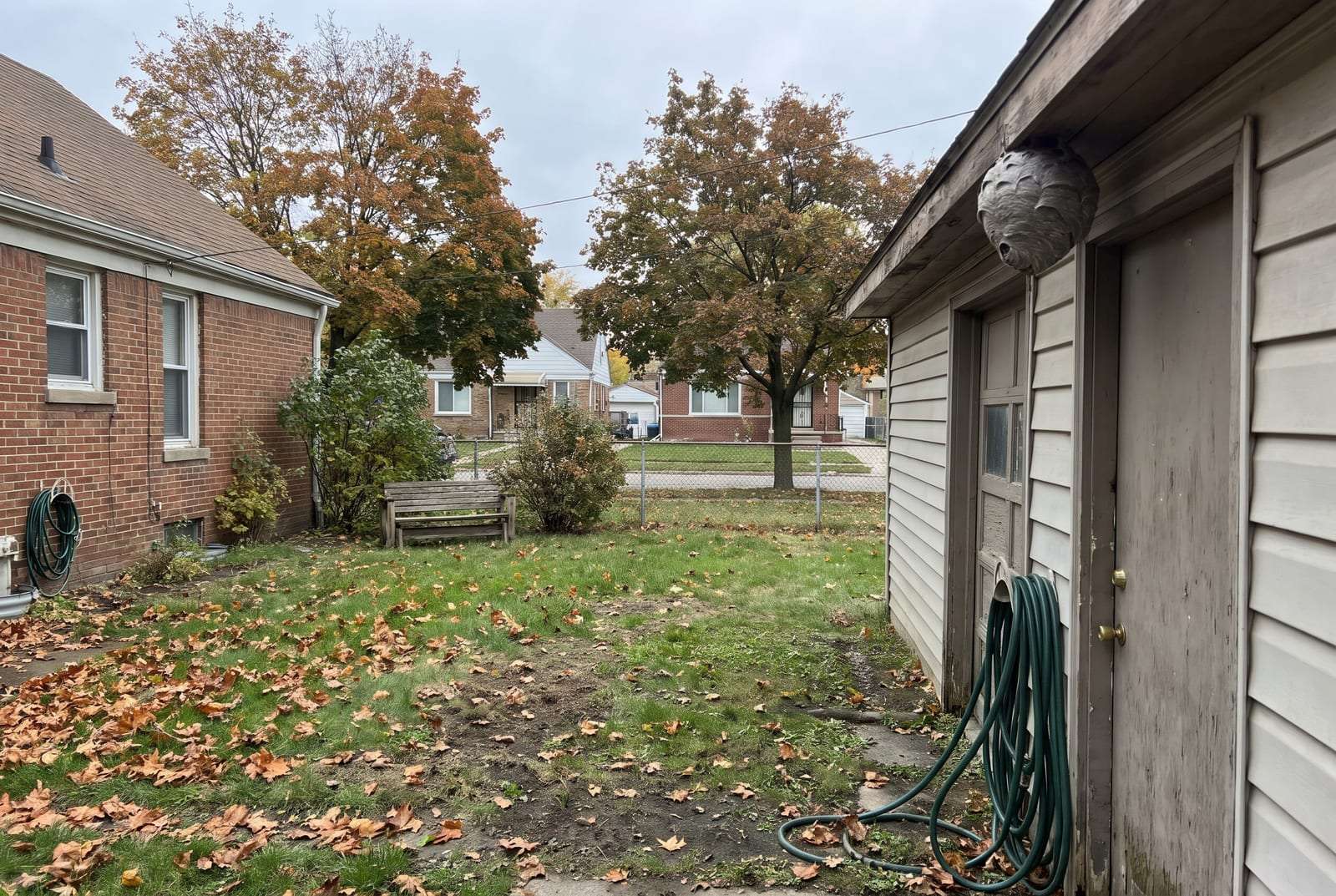
- A gray, papery nest under the eaves, a porch ceiling or a deck rail, or inside a shed
- Buzzing or a faint scratching inside a wall or ceiling
- Wasps turning up indoors on warm days, near windows or light fixtures
- Aggressive insects that dive at people near a door or along a walkway
Wasp, Hornet or Bee?
Stinging insects aren’t all handled the same way. Wasps and hornets nesting on or in the house are a pest job. Honeybees are valuable pollinators, and a hive or a swarm is usually moved by a beekeeper rather than treated. Knowing which one you have changes what happens next.
| What it looks like | Nest type | Behavior | Treated as a pest job? |
|---|---|---|---|
| Paper wasp: slim, with long legs that dangle in flight; brown or black with yellow or reddish marks | Open gray paper comb shaped like an upside-down umbrella, under eaves, railings and shed roofs | Fairly calm unless the nest is bumped or a door slams beside it | Yes |
| Yellowjacket: short and stocky, with bright yellow and black bands; fast and darting | Hidden paper nest in the ground, a wall cavity or an attic, with one small entrance | Defensive near the nest; bold around food, drinks and trash in late summer | Yes |
| Bald-faced hornet: large and black, with white markings on the face and tail | Gray, football-shaped paper nest in a tree, a shrub or high on the house | Very defensive; will chase if the nest is disturbed | Yes |
| Honeybee: fuzzy and golden brown, a bit smaller than a yellowjacket | Wax comb inside a hollow tree or a wall; spring swarms hang as a cluster on a branch | Gentle away from the hive; a resting swarm is usually calm | No: usually moved by a beekeeper |
| Bumblebee: large, round and very fuzzy, black and yellow | Small nest in the ground, an old burrow, under a deck or in loose insulation | Gentle; stings mostly when handled or stepped on | Usually not: the nest dies off in autumn, and the bees are important pollinators |
How a Wasp or Hornet Nest Comes Down
Nest removal looks simple from the ground, and that’s the trouble. The insects flying around are the guards and foragers; the rest are inside, and they all come out when the nest is disturbed. A typical removal goes like this:
- Identify the insect and find the nest. That means every entrance, since a yellowjacket nest in a wall or under a deck may show only one small hole.
- Treat at dusk or early morning. That’s when the colony is home and less active, and cooler air slows them down.
- Wait. The product needs time to work through the nest, often a day or so, before anything is pulled down.
- Take the nest down. Once the activity stops, the nest is scraped off or cut out and bagged.
- Clean up. Bits of paper nest and dead insects are cleared away, so nothing is left to attract others.
- Check the roofline. Eaves, soffits, sheds, porch ceilings and play sets often hide another nest nearby.
Nests inside walls need extra care. Sealing the hole while the colony is still active can push yellowjackets to chew through the drywall and come out inside the house. The opening is usually closed only after the activity has stopped for good.
What to Do and Not Do Near a Nest
Until the nest is dealt with, a few rules keep everyone out of harm’s way.
- Don’t spray a nest from a ladder. Angry wasps and a ladder are how bad falls happen.
- Don’t seal a hole in a wall with wasps still inside; they may chew their way into the house.
- Don’t use fire, gasoline or a hose on a nest. Fire can catch the house, and water only scatters angry insects.
- Keep kids and pets away from the area, and keep nearby windows and doors closed.
- Don’t mow, trim or walk right next to a ground nest; the vibration sets them off.
- Cover sweet drinks and food outdoors, especially in late summer.
- Note where they fly in and out, and what time of day they’re busiest. That helps find the nest.
Questions About Stings, Allergies and Last Year’s Nest
When is a sting serious enough to call 911?
If anyone stung has trouble breathing, swelling of the face, lips, tongue or throat, dizziness, or hives spreading across the body, call 911 first. Those are signs of a serious allergic reaction, and the nest can wait. If the person has a prescribed epinephrine auto-injector, use it as their doctor directed.
Many stings at once can make someone sick even without an allergy, especially a child or an older adult. When in doubt, get medical help first and call us about the nest afterward.
Someone in our house is allergic to stings. What should we do in the meantime?
Keep that person well away from the nest, use a different door if the nest is near one, and keep their medicine easy to reach. Mention the allergy when you call, so the timing of the work and the area to stay out of can be planned around them.
Will the wasps use the same nest next year?
Most paper nests are not reused. In autumn the colony dies off, and only the new queens survive the winter, tucked into sheltered spots like wall gaps, attics, loose bark and woodpiles. In spring each queen starts a new nest from scratch, often in the same kind of sheltered spot: the same eave, the same shed corner.
That’s why it pays to look over the roofline in spring, when a new nest is no bigger than a golf ball and only the queen is tending it. An old, empty nest from last year can be knocked down in winter; nothing lives in it.
Why are yellowjackets so aggressive in late summer?
By late summer a yellowjacket colony is at its biggest, and the workers switch from hunting insects to looking for sugar. That brings them to trash cans, soda cans, fruit trees and picnic tables, right where people swat at them. A nest near a door or a walkway at that time of year is worth dealing with rather than waiting out.
Nest Growing Over the Back Door?
Keep your distance, note where the insects are coming and going, and tell us what you’ve seen. Call (313) 351-0267, or Schedule a Visit and let us know where on the property the nest is.